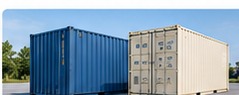
A 20ft is the more compact choice; a 40ft provides roughly twice the floor area. Choose using your storage layout and the confirmed delivery plan, then compare the full delivered price rather than assuming the longer unit costs twice as much.
The practical comparison
Both standard formats are nominally 8ft wide and 8ft 6in tall outside. Choosing 40ft gives you more length, not a wider doorway. Tall loads may require a separate standard-versus-high-cube comparison.
| Decision | 20ft | 40ft |
|---|---|---|
| External floor footprint | 160ft² | 320ft² |
| Storage layout | Shorter retrieval distance | More zones and longer access aisle |
| Site planning | Smaller permanent footprint | Longer placement area |
| Delivery | Still needs truck access | Confirm longer run-out and turns |
| Cost comparison | Request a delivered quote | Compare cost per usable storage area |
When a 20ft is the better fit
Start with a 20ft when the storage requirement is modest, the site is constrained or reaching everything from one end matters. It can be easier to organize a smaller unit than to pay for excess space that gradually fills with low-value overflow.
Do not choose it solely because the property entrance looks tight. A smaller container may still arrive on a substantial truck. Let the carrier review the route before assuming a 20ft order solves access restrictions.
When a 40ft is worth the space
A 40ft suits a larger inventory, longer materials or a layout divided into separate zones. Sketch frequently accessed items near the doors and occasional stock farther back. The value of the additional length depends on whether you can reach and use it.
If the delivery quote is similar to the shorter unit, the larger container may offer better space per dollar. That is a quote-specific comparison, not a rule. Include foundation work and the ongoing value of the yard space it occupies.
One 40ft or two 20ft units?
Two units can separate tools from inventory or provide access from different positions. They may also let you stage a purchase as the business grows. Against that, count both purchase prices, deliveries, locks and placement work.
Write out the likely daily movements: how often a person crosses between units, where loading happens and what must be retrieved. The useful comparison is operational layout and total cost, not just nominal capacity.
Compare cost per usable area carefully
For an illustrative calculation, imagine delivered quotes of $3,200 for a 20ft and $4,600 for a 40ft. Dividing by the external footprints gives $20 and about $14.38 per square foot. These invented figures show the method; they are not market prices.
Now repeat the calculation using the part of your floor plan you can actually use. If half the larger box would remain unnecessary, its lower cost per square foot is not a reason to spend more. Choose enough useful space with an appropriate allowance for expected growth.
Common questions
Does a 40ft hold twice as much?
It provides roughly twice the floor space and empty interior volume of a 20ft standard. Practical capacity depends on packing, access and load limits.
Is a 20ft always cheaper to deliver?
No. Distance, truck type, routing and unloading conditions affect the quote. Compare actual delivered totals.
Sources & approach
Technical references and supplier guidance used for this guide. Recommendations and worked examples are EzyTrader’s editorial analysis; supplier-specific requirements still need confirmation.
- Hapag-Lloyd: 20ft standard fleet specifications
- Hapag-Lloyd: 40ft standard fleet specifications
- Eveon: delivery methods and site requirements
Images are illustrative, not available inventory. Read our editorial approach.